Aluminum Tubes Manufacturer & Supplier
Lightweight aluminum alloy tubing in 6061, 6063 and 3003 for heat exchangers, transport structures and industrial equipment — seamless or welded, mill finish or anodized.
Quote Now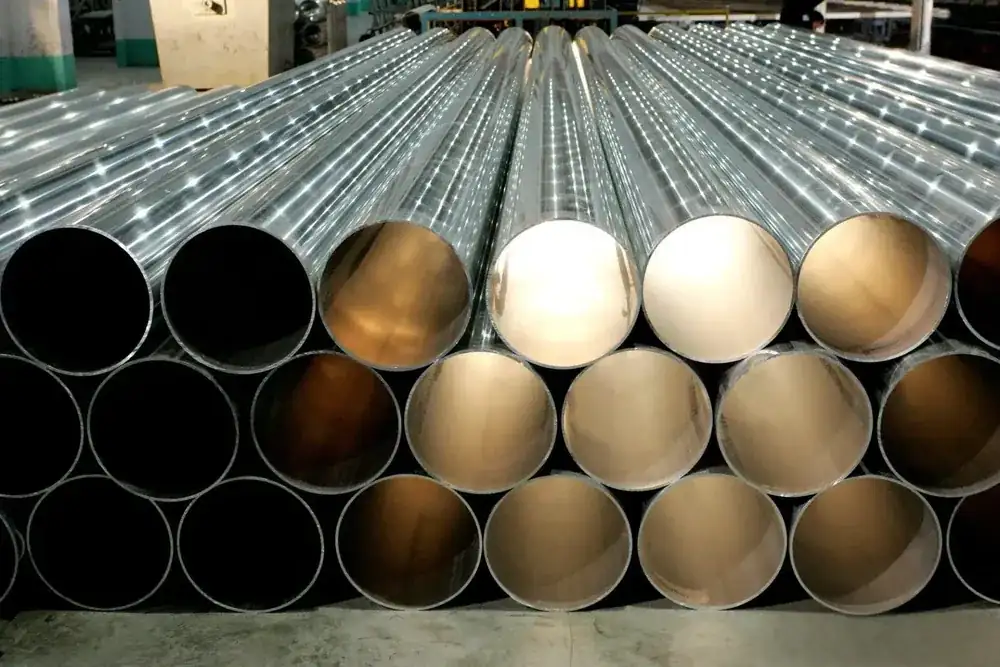
What Are Aluminum Tubes?
Aluminum tubes are tubular products made from aluminum alloy, typically one third the weight of an equivalent steel tube. That weight advantage, combined with good thermal conductivity and natural oxide corrosion resistance, makes aluminum the default choice for heat transfer, transport structures and equipment that has to stay light.
Seamless tube is produced by extrusion and is preferred where pressure tightness and uniform wall matter. Welded tube is formed from coil and welded along the seam, offering thinner walls and lower cost for structural and decorative use.
Tubes are cut to length, deburred and packed at our Cangzhou facility, with anodizing, powder coating or protective wrapping available according to the application and shipping route.
Aluminum Tube Specifications
Alloy, temper and production route determine strength, formability and corrosion behaviour. The table below summarises the common combinations; final selection should follow the drawings and the service environment.
| Product Name | Aluminum Tubes / Aluminum Alloy Tubing |
|---|---|
| Common Alloys | 6061, 6063, 3003, 5052 (other alloys on request) |
| Temper | O, T4, T5, T6 as required |
| Production Route | Seamless extruded tube or welded tube |
| Outer Diameter (OD) | 6–200 mm |
| Wall Thickness (WT) | 0.5–20 mm |
| Tube Length | Up to 6 m, or cut to project length |
| Applicable Standards | ASTM B210, ASTM B241, EN 755, GB/T 6893, subject to product type |
| Surface Finish | Mill finish, anodized, powder coated, or protective wrapped |
| Tube Ends | Plain end, cut square, or deburred for assembly |
| Inspection | Dimensional check, wall thickness, straightness, surface and pressure test as specified |
| Documentation | Material certificate with chemical composition and mechanical properties |
| Applications | Heat exchangers, condensers, transport structures, pneumatic lines, frames, architectural profiles |
Note: Available alloys, tempers and dimensions are subject to production capability and order specifications. Please contact Starkpipes to confirm availability.
Alloy Selection Guide
| Alloy | Characteristic | Typical Use |
|---|---|---|
| 6061 | Good strength, weldable, heat treatable | Structural frames, pressure tubing, machined parts |
| 6063 | Excellent extrusion finish, moderate strength | Architectural profiles, furniture, decorative tube |
| 3003 | Good formability and corrosion resistance, not heat treatable | Heat exchangers, condensers, low-pressure lines |
| 5052 | High corrosion resistance, good formability | Marine, chemical and outdoor applications |
Seamless vs Welded Aluminum Tube
The production route affects pressure capability, wall uniformity and cost. It should be stated explicitly rather than left to the supplier.
Seamless (Extruded)
No weld seam, uniform wall and better pressure containment. Suited to heat exchanger tubes, hydraulic and pneumatic lines, and parts that are machined after forming.
Welded
Formed from coil and welded along the seam. Thinner walls are possible, cost is lower, and it suits structural, furniture and decorative applications where pressure duty is light.
Galvanic Corrosion Warning
Aluminum sits high in the galvanic series and will corrode preferentially when coupled with steel, stainless steel or copper in the presence of moisture. Where aluminum tube is fixed to a steel structure, an insulating barrier or isolating washer should be used, and fasteners should be selected accordingly.
Applications of Aluminum Tubes
Aluminum tubing is selected where weight, thermal performance or corrosion resistance outweighs the higher unit cost compared with steel.
Heat Exchangers
Condenser and radiator tubes where thermal conductivity and corrosion resistance drive the design.
Transport Structures
Trailer frames, bus bodywork, rail interiors and roof racks where weight reduction matters.
Pneumatic & Fluid Lines
Compressed air, lubrication and low-pressure fluid transfer lines in industrial plants.
Architectural Profiles
Handrails, frames, shopfronts and decorative tube, usually anodized or powder coated.
Handling and Quality Control
Aluminum is softer than steel and marks easily, so surface protection through cutting, packing and shipping is part of the specification rather than an afterthought.
Dimensional Check
OD, wall thickness, straightness and length verified against the order.
Surface Inspection
Scratches, dents and die lines checked, since appearance is often critical.
Protective Packing
Interleaved or sleeved bundles to prevent abrasion during transport.
Certification
Material certificate with alloy, temper and mechanical properties.
FAQ
Related Products
Further Reading & Applications
Manufacturing route
Project experience
Need help selecting a grade or wall thickness? Read the steel pipe FAQ · send your specification.
Request a Steel Pipe Quote
Share your technical requirements. We provide compliant, high-performance pipe solutions with a guaranteed 24-hour response time.
- ✓ Strict adherence to API 5L & International Standards
- ✓ Tailored production for custom OD, WT, and steel grades
- ✓ End-to-end logistics support to your specified port