
Galvanized Steel Pipe Manufacturer & Supplier
Zinc coated steel pipes for water supply, gas distribution, fire protection and outdoor structural service — available to ASTM A53, EN 10255 and GB/T 3091.
Quote Now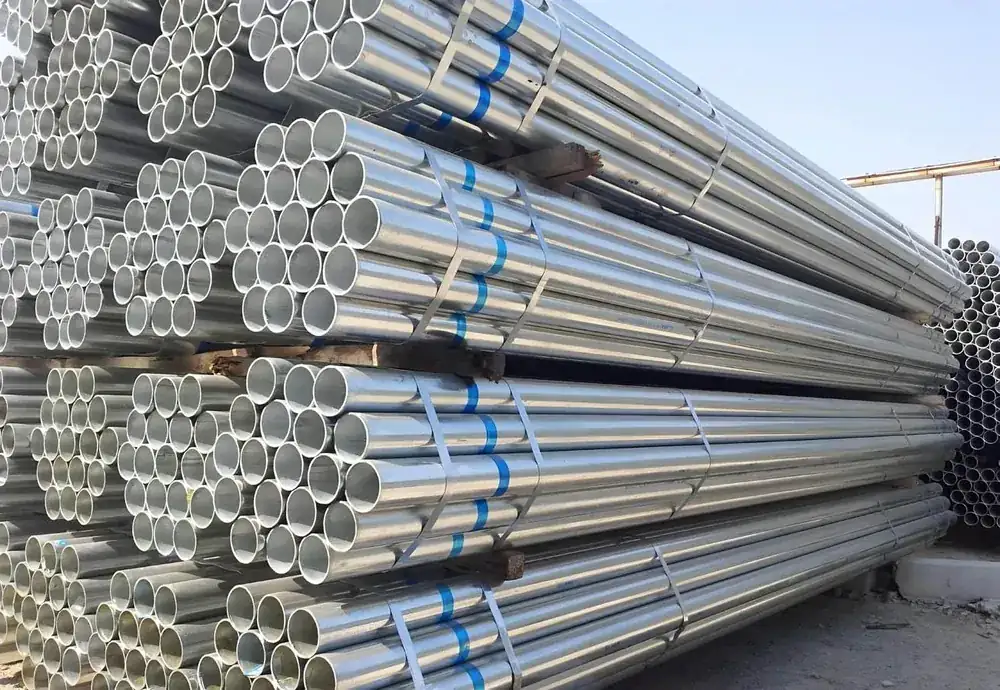
What Is Galvanized Steel Pipe?
Galvanized steel pipe is a carbon steel pipe with a metallic zinc coating applied to its internal and external surfaces. The zinc layer protects the base steel through a combination of a physical barrier and sacrificial anode action — when the coating is scratched, the surrounding zinc continues to corrode preferentially and protects the exposed steel.
Hot-dip galvanizing is the most common process for pipe used in water, gas and outdoor service. Electro-galvanizing deposits a thinner coating and is generally specified where a smoother finish or tighter dimensional control is required. Coating class, zinc mass and acceptance criteria are defined by the applicable product standard and purchase order.
Galvanized pipes are inspected and finished at our Cangzhou facility, where coating mass, dimensions and thread quality are verified against the purchase order before packing. Cutting, threading, grooving and end protection are carried out in-house, so the pipe leaves us ready for installation rather than as a bare mill bundle.
Galvanized Steel Pipe Specifications
Galvanized steel pipes are supplied in a range of nominal sizes, wall thicknesses and end configurations for water, gas, fire protection and structural applications. Dimensions and coating requirements should be confirmed against the applicable standard before ordering.
| Product Name | Galvanized Steel Pipe |
|---|---|
| Base Pipe | ERW welded steel pipe or seamless steel pipe, as specified |
| Coating Process | Hot-dip galvanizing (HDG) or electro-galvanizing, as specified |
| Nominal Size | DN15–DN600 (1/2"–24") |
| Outside Diameter (OD) | 21.3–610 mm |
| Wall Thickness (WT) | 1.8–20 mm |
| Pipe Length | 5.8 m, 6 m, 12 m, or customized lengths |
| Steel Grades | ASTM A53 Grade A / B, EN 10255 S195T / S235JRH, GB/T 3091 Q195–Q235, and other available grades |
| Applicable Standards | ASTM A53, EN 10255, ISO 65, GB/T 3091, subject to product type and requirements |
| Zinc Coating | Coating class and minimum zinc mass according to the specified standard (for example EN 10255 Light / Medium / Heavy, or ASTM A53 minimum coating requirements) |
| Pipe Ends | Plain end, threaded end (BSP / NPT), grooved end, with or without couplings |
| Surface Finish | Bright zinc finish; chromate passivation optional; suitable for subsequent painting |
| Inspection | Coating mass or thickness, dimensional inspection, visual examination, hydrostatic testing as required |
| Documentation | Material Test Certificate (MTC) and third-party inspection reports upon request |
| Applications | Water supply, gas distribution, fire protection systems, scaffolding, outdoor structures, general industrial piping |
Note: Available sizes, grades, coating classes and end finishes are subject to production capability and order specifications. Please contact Starkpipes to confirm availability for your project.
Galvanized Steel Pipe Tolerances
| Parameter | Tolerance Requirements |
|---|---|
| Outside Diameter | According to the applicable product standard and specified nominal size |
| Wall Thickness | According to the applicable product standard and specified wall class |
| Length | According to the specified length category and purchase order |
| Zinc Coating Mass | According to the specified coating class and the test method defined in the applicable standard |
| Straightness and Ovality | According to the applicable standard and project requirements |
Galvanized Steel Pipe Standards and Grades
Galvanized steel pipes can be supplied to international standards covering water and gas service, threaded pipe, and structural applications. Grade and coating class selection depends on the operating pressure, installation method and expected service life.
ASTM A53
ASTM A53 covers welded and seamless steel pipe, black and hot-dipped zinc coated, for mechanical and pressure applications and ordinary structural use. Grade A and Grade B are commonly specified, and tensile and bending requirements apply to the finished pipe.
EN 10255 / ISO 65
EN 10255 (harmonised with ISO 65) covers welded and seamless steel tubes for threading and other joining methods. Three wall thickness classes — Light, Medium and Heavy — are defined, each with corresponding zinc coating classes. Common grades include S195T and S235JRH.
GB/T 3091
GB/T 3091 covers welded steel pipes for low-pressure liquid service, widely used for water, gas and heating systems. Q195 to Q235 grades are typical, and both black and hot-dip galvanized finishes are covered where specified.
Selecting the Right Standard and Coating Class
When specifying galvanized steel pipe, buyers should confirm the applicable standard, steel grade, nominal size, wall class, zinc coating class, end finish and required inspection documents. For buried or high-humidity service, additional coating systems such as 3LPE may be specified over the base pipe instead of, or in addition to, galvanizing.
Hot-Dip Galvanizing Process
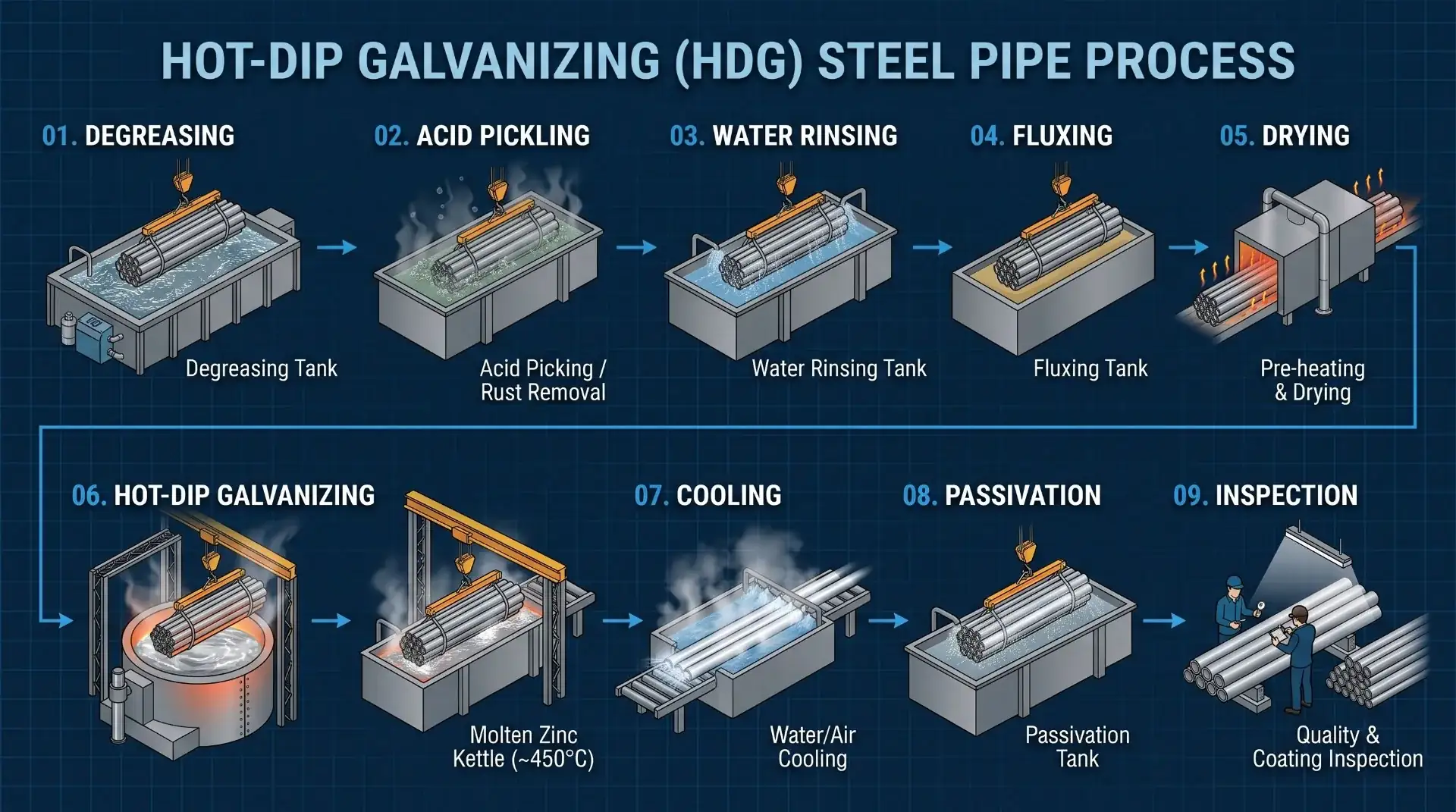
In the hot-dip process, the finished pipe is cleaned and then immersed in molten zinc, forming a metallurgically bonded zinc-iron alloy layer that is thicker and more durable than an electro-deposited coating. The sequence below describes the conventional batch hot-dip route.
Key Manufacturing Stages
-
01
Degreasing
Oil, grease, drawing lubricant and dirt are removed in an alkaline degreasing tank, so that the acid can act evenly on the steel surface.
-
02
Acid Pickling
The pipe is pickled in acid to strip mill scale, rust and surface oxides, exposing clean steel for the zinc-iron reaction.
-
03
Water Rinsing
Residual acid and dissolved salts are rinsed off in clean water, so that contamination is not carried into the flux bath.
-
04
Fluxing
A flux layer is applied to the cleaned surface. It prevents re-oxidation before dipping and promotes wetting by the molten zinc.
-
05
Drying
The fluxed pipe is dried and preheated in an oven, so that no moisture enters the zinc kettle and causes spatter or blowholes.
-
06
Hot-Dip Galvanizing
The pipe is immersed in molten zinc until it reaches bath temperature, forming a metallurgically bonded zinc-iron alloy layer on the whole surface, inside and out.
Molten zinc temperature: typically 445–465 °C.
-
07
Cooling
After withdrawal the pipe is cooled in water or air under controlled conditions, which sets the coating structure and brings the bundle down to handling temperature.
-
08
Passivation
Where specified, a chromate or alternative passivation is applied to limit white rust (wet storage stain) during transport and storage.
-
09
Inspection
Coating mass or thickness, adhesion, uniformity and appearance are checked against the applicable standard. Threading or grooving, marking and bundling follow as ordered.
Threading and grooving are normally performed after galvanizing so that the cut surfaces can be protected with zinc-rich repair coating. Where this matters for corrosion performance, it should be stated in the purchase order.
Hot-Dip vs Electro-Galvanized Pipe
The two processes produce different coating structures and are not interchangeable. Selection depends on service environment, expected life and finish requirements.
| Parameter | Hot-Dip Galvanized | Electro-Galvanized |
|---|---|---|
| Coating formation | Zinc-iron alloy layer bonded by immersion in molten zinc | Electrolytically deposited pure zinc layer |
| Coating thickness | Relatively thick, defined by coating class | Thin and uniform |
| Surface appearance | Matte to bright grey, may show slight zinc spangle | Smooth, bright and uniform |
| Typical service | Outdoor, buried, water and gas service requiring long corrosion life | Indoor or mild exposure where appearance and dimensional precision matter |
| Threading suitability | Commonly threaded after coating with repair coating applied | Limited; coating is easily damaged by threading |
The comparison above is provided for general guidance. Final selection should follow the project specification and the coating requirements of the applicable standard.
Applications of Galvanized Steel Pipe
Galvanized steel pipes are used where carbon steel would corrode too quickly in normal service. The required coating class, wall thickness and joining method depend on the medium, pressure and installation environment.
Water Supply
Municipal water distribution, building services and irrigation lines, typically to EN 10255 Medium or GB/T 3091.
Gas Distribution
Low-pressure gas service piping with threaded joints, subject to the applicable local code and utility requirements.
Fire Protection
Sprinkler and standpipe systems where galvanized or black pipe is accepted by the approved system design.
Structure & Scaffolding
Outdoor frames, guardrails, scaffolding tubes and general fabrication exposed to weather.
Quality Control at Our Cangzhou Facility
Every galvanized pipe order passes through our own inspection process before it is released for shipment. Coating is measured, dimensions are verified and thread quality is checked, with results recorded against the heat number and purchase order.
Coating Mass Testing
Zinc coating mass checked by the weighing method and compared against the specified coating class.
Dimensional & Thread Check
OD, wall thickness, length, straightness, thread gauge and coupling fit verified per standard.
Pressure Testing
Hydrostatic testing at the pressure required by the purchase order, with test records retained.
Traceability & Documents
MTC 3.1, inspection records and third-party reports available; heat numbers marked per bundle.
Export packing is arranged with end caps, PVC wrap, steel strips and fumigated wood where required, and loading can be supervised by our team at the port of departure. If your project requires a third-party inspection agency, we coordinate the visit and prepare the pipe for review.
FAQ
Related Products
Further Reading & Applications
Galvanizing & zinc coating
Project experience
Need help selecting a grade or wall thickness? Read the steel pipe FAQ · send your specification.
Request a Steel Pipe Quote
Share your technical requirements. We provide compliant, high-performance pipe solutions with a guaranteed 24-hour response time.
- ✓ Strict adherence to API 5L & International Standards
- ✓ Tailored production for custom OD, WT, and steel grades
- ✓ End-to-end logistics support to your specified port