
FBE Coated Steel Pipe Manufacturer & Supplier
Fusion Bonded Epoxy (FBE) coated steel pipes providing exceptional corrosion protection, strong adhesion, and electrical insulation for demanding pipeline systems.
Quote Now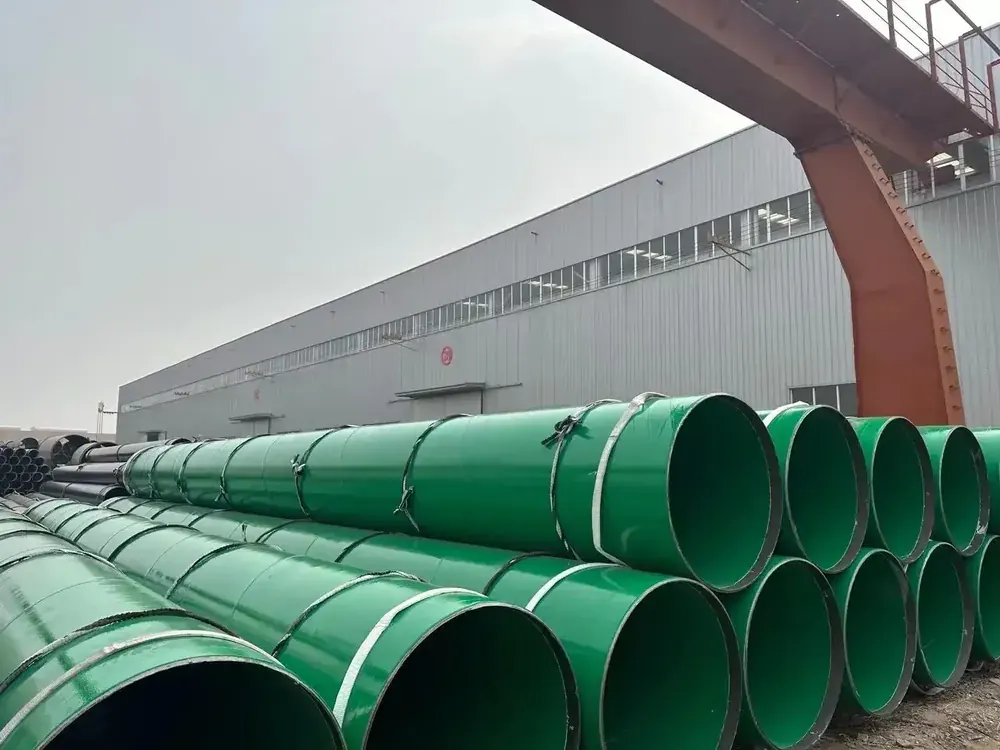
What Is FBE Steel Pipe?
FBE steel pipe is carbon steel pipe coated with Fusion Bonded Epoxy (FBE) powder to provide corrosion protection in pipeline systems. Applied to a properly prepared steel surface and cured by heat, the epoxy coating forms a strongly bonded, electrically insulating barrier that helps protect the steel against corrosion.
Starkpipes supplies FBE coated steel pipes for oil and gas transmission, water infrastructure, and industrial pipeline projects. Base pipe dimensions, steel grades, coating thickness, and inspection requirements can be specified according to project requirements.
Key Features of FBE Coated Steel Pipe
- 🛡️ Corrosion resistance: Protects the steel substrate against moisture and corrosive environments.
- 🔗 Strong adhesion: Bonds to properly prepared steel surfaces through a controlled fusion and curing process.
- ⚡ Electrical insulation: Helps isolate the steel surface from its surroundings and can complement cathodic protection systems.
- 📏 Uniform coating: Factory application supports consistent coating thickness and quality inspection.
- 🔄 Flexible coating options: Single-layer and dual-layer FBE systems can be selected according to project requirements.
FBE Steel Pipe Specifications
FBE steel pipe specifications depend on the base pipe, steel grade, coating system, operating conditions, and applicable standards.
| Parameter | Specifications |
|---|---|
| Base Pipe Type | LSAW, SSAW, ERW/HFW or seamless |
| Outside Diameter | Project-specific; confirm available pipe and coating line capacities |
| Wall Thickness | Determined by pipe type, design requirements, and manufacturing capabilities |
| Steel Grade | API 5L Gr. B, X42, X52, X60, X65, X70, X80 and other specified grades |
| Coating Type | Single-layer FBE or dual-layer FBE |
| Coating Thickness | Commonly around 300–500 μm for single-layer systems |
| Pipe Length | Project-specific |
| Coating Standards | ISO 21809-2, CAN/CSA Z245.20 or other applicable specifications |
| Pipe Ends | Plain or beveled ends with specified coating cutback |
| Quality Inspection | Visual inspection, thickness measurement, holiday detection and specified tests |
Note: Final dimensions, coating thickness, test methods, and acceptance criteria must be confirmed against the applicable standard, coating system, and project specification.
FBE Steel Pipe Structure
A standard single-layer FBE coated steel pipe consists of two main components: the steel pipe substrate and the fusion-bonded epoxy coating.
| Component | Material | Function |
|---|---|---|
| Protective Coating | Fusion Bonded Epoxy | Provides corrosion resistance, adhesion, and electrical insulation |
| Base Pipe | Carbon Steel | Provides mechanical strength and pressure-bearing capacity |
Unlike 3LPE and 3LPP systems, standard single-layer FBE does not include a separate adhesive layer or a polyethylene or polypropylene outer layer. Dual-layer FBE systems are also available when additional mechanical protection is required.
FBE Steel Pipe Manufacturing Process
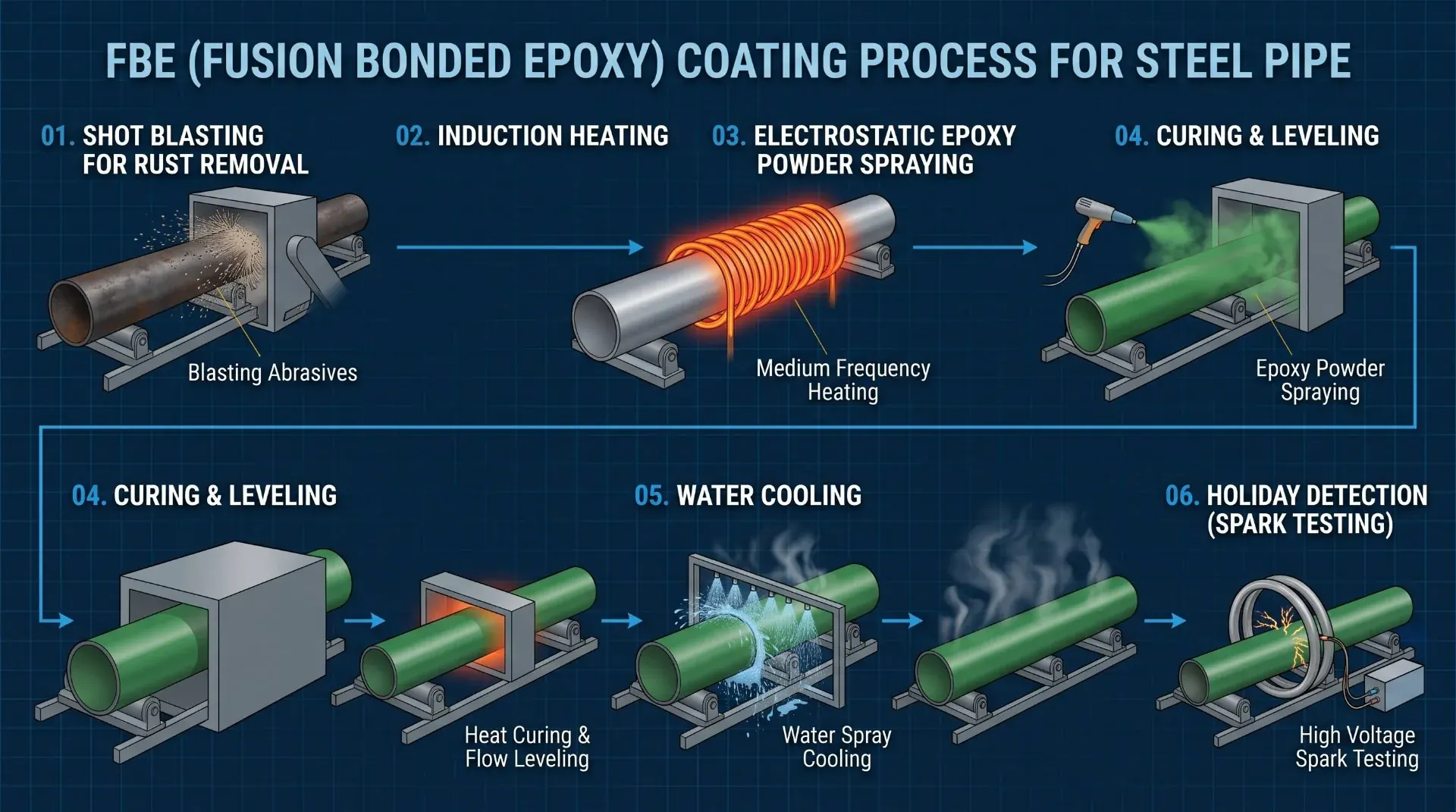
FBE coating involves surface preparation, preheating, epoxy powder application, curing, and final inspection to ensure coating adhesion and corrosion protection.
Key Manufacturing Stages
-
01
Shot Blasting for Rust Removal
Pipes are abrasive-blasted to remove rust, mill scale, old coating and other contaminants, giving the anchor profile the epoxy needs to key into.
Cleaning standard: ISO 8501-1, Sa 2½. Surface profile: typically 50–100 μm.
-
02
Induction Heating
The blasted pipe passes through medium-frequency induction coils and is heated to the temperature required by the powder system, with the temperature checked before spraying.
Typical pipe temperature: approximately 200–250 °C.
-
03
Electrostatic Epoxy Powder Spraying
Charged epoxy powder is sprayed onto the rotating hot pipe. The powder melts on contact, wets the steel and flows into a continuous film as the pipe rotates.
Typical single-layer DFT: approximately 300–500 μm.
-
04
Curing & Leveling
The coated pipe passes through the curing oven, where the film flows out and cross-links to develop the final adhesion, hardness and chemical resistance.
-
05
Water Cooling
Water spray cooling brings the coated pipe down to a safe handling temperature and stops further reaction of the film.
-
06
Holiday Detection (Spark Testing)
A high-voltage spark test is run over the full coated surface to detect pinholes, thin spots and mechanical damage, followed by thickness measurement and adhesion testing per the project specification.
Applications of FBE Coated Steel Pipe
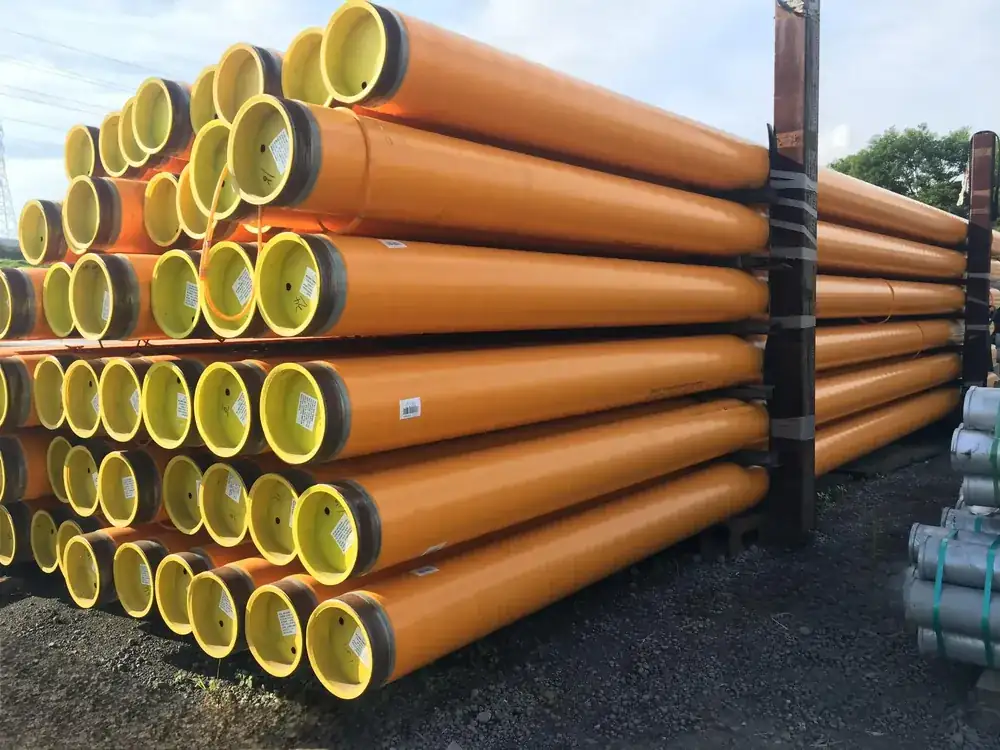
FBE coated steel pipes are used in projects requiring corrosion protection and reliable coating adhesion. The appropriate coating system depends on the transported medium, operating conditions, and installation environment.
🛢️ Oil and Gas Transmission
FBE is widely used for external corrosion protection on buried oil and gas pipelines. Coating selection should consider soil conditions, operating temperature, cathodic protection, and installation requirements.
💧 Water Supply & Transmission
FBE coatings can protect the external surfaces of steel water transmission pipes. Internal FBE lining may also be specified when compatible with the water quality and applicable requirements.
⚙️ Industrial Pipelines
FBE coated pipes are suitable for selected industrial fluid transport systems where the coating is compatible with the service environment and operating conditions.
🏙️ Infrastructure & Utility
FBE coatings are used in selected buried utility pipelines and infrastructure projects where factory-applied corrosion protection is required.
FBE vs. 3LPE vs. 3LPP Steel Pipe
FBE, 3LPE, and 3LPP are different coating systems used to protect steel pipes against corrosion. The choice depends on operating temperature, mechanical protection requirements, and installation conditions.
| Comparison | FBE | 3LPE | 3LPP |
|---|---|---|---|
| Coating Structure | Fusion-bonded epoxy | Epoxy, adhesive, polyethylene | Epoxy, adhesive, polypropylene |
| Main Advantage | Adhesion and corrosion protection | Corrosion and mechanical protection | Corrosion and mechanical protection at higher temperatures |
| Mechanical Protection | Depends on coating system | Generally strong | Generally strong |
| Temperature Suitability | Depends on epoxy formulation | Depends on the specified system | Often selected for higher-temperature service |
| Typical Selection | Projects prioritizing FBE coating performance | General buried pipeline protection | Projects requiring enhanced temperature resistance |
Actual performance depends on coating formulation, thickness, qualification testing, operating conditions, and installation practices. Final selection should be based on the project specification rather than coating type alone.
FAQ
Related Products
Further Reading & Applications
FBE in the field
Need help selecting a grade or wall thickness? Read the steel pipe FAQ · send your specification.
Request a Steel Pipe Quote
Share your technical requirements. We provide compliant, high-performance pipe solutions with a guaranteed 24-hour response time.
- ✓ Strict adherence to API 5L & International Standards
- ✓ Tailored production for custom OD, WT, and steel grades
- ✓ End-to-end logistics support to your specified port