OCTG Casing Pipe Manufacturer & Supplier
High-performance OCTG casing pipes for wellbore stability, formation isolation, and well integrity in demanding onshore and offshore drilling operations.
Quote Now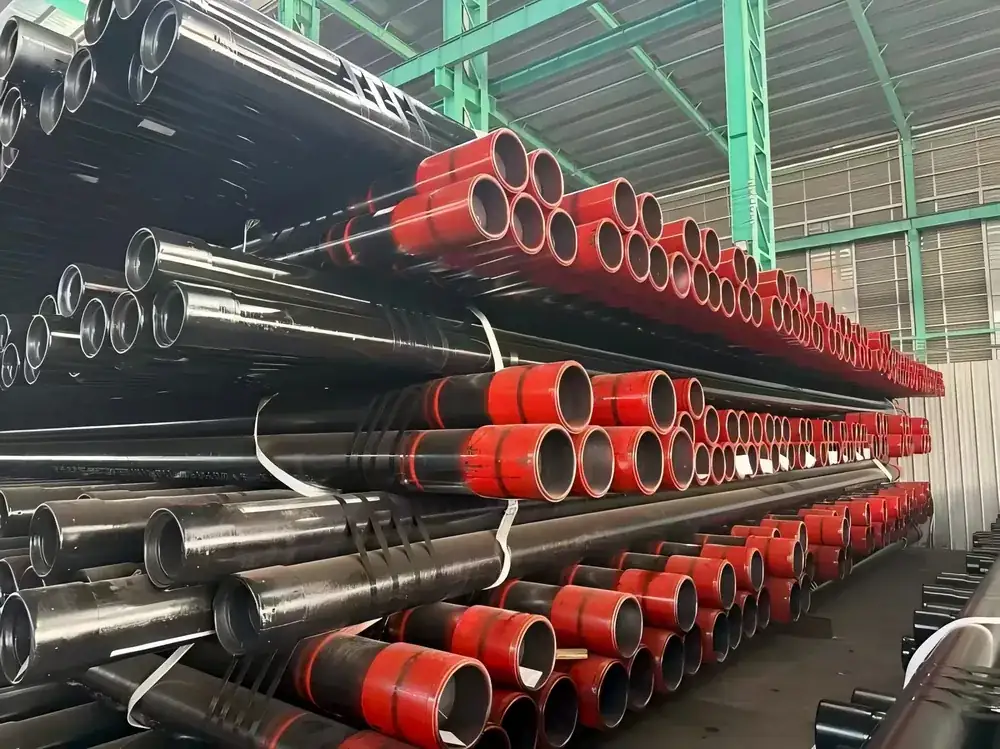
What Is OCTG Casing Pipe?
OCTG casing pipe is a steel tubular product installed in oil and gas wells to stabilize the wellbore, isolate geological formations, and maintain well integrity during drilling and production.
Its performance depends on steel grade, wall thickness, connection design, and resistance to axial, burst, and collapse loads. Starkpipes supplies casing manufactured to API Spec 5CT standards to meet the critical demands of the upstream energy sector.
OCTG Casing Pipe Specifications
OCTG casing pipe specifications are determined by well depth, formation pressure, temperature, fluid composition, and installation conditions. Key parameters include outside diameter, nominal weight, wall thickness, steel grade, pipe length, and connection type.
| Parameter | Specification |
|---|---|
| Product | OCTG Casing Pipe |
| Applicable standard | API Spec 5CT |
| Manufacturing process | Seamless or welded, subject to applicable requirements |
| Common steel grades | J55, K55, N80, L80, P110, C90, T95, C110, Q125 |
| Outside diameter | Selected from applicable API 5CT dimension tables |
| Nominal weight | Specified in lb/ft or kg/m |
| Wall thickness | Determined by the selected size and nominal weight |
| Pipe length | API-defined Range 1, 2, or 3, as specified |
| Connections | STC, LTC, BTC, or specified premium connections |
| Supply condition | Plain-end or threaded and coupled, as ordered |
| Inspection documentation | Material test reports and agreed inspection records |
Note: Final dimensions, manufacturing routes, grades, and connection options must be confirmed against the applicable standard edition and project requirements.
OCTG Casing Pipe Size Chart
The following table lists selected common casing sizes and nominal weight combinations for reference.
| Nominal Size (in) | OD (mm) | Nominal Weight (lb/ft) | Wall Thickness (mm) |
|---|---|---|---|
| 4-1/2" | 114.3 | 9.50 | 5.21 |
| 4-1/2" | 114.3 | 11.60 | 6.35 |
| 4-1/2" | 114.3 | 13.50 | 7.37 |
| 5" | 127.0 | 11.50 | 5.59 |
| 5" | 127.0 | 13.00 | 6.43 |
| 5-1/2" | 139.7 | 14.00 | 6.20 |
| 5-1/2" | 139.7 | 17.00 | 7.72 |
| 5-1/2" | 139.7 | 20.00 | 9.17 |
| 6-5/8" | 168.3 | 20.00 | 7.32 |
| 6-5/8" | 168.3 | 24.00 | 8.94 |
| 7" | 177.8 | 23.00 | 8.05 |
| 7" | 177.8 | 26.00 | 9.19 |
| 7" | 177.8 | 29.00 | 10.36 |
| 7" | 177.8 | 32.00 | 11.51 |
| 9-5/8" | 244.5 | 36.00 | 8.94 |
| 9-5/8" | 244.5 | 40.00 | 10.03 |
| 9-5/8" | 244.5 | 47.00 | 11.99 |
| 13-3/8" | 339.7 | 54.50 | 9.65 |
| 13-3/8" | 339.7 | 68.00 | 12.19 |
- Nominal weight in lb/ft is commonly used to identify casing size and wall-thickness combinations.
- This table includes selected combinations rather than the complete API 5CT dimension range.
- Actual steel-grade availability and connection compatibility must be confirmed for each order.
- Final dimensions, tolerances, drift diameter, and end-finishing requirements should be checked against the applicable API 5CT edition and purchase specification.
OCTG Casing Pipe Steel Grades
Steel grade selection affects yield strength, mechanical properties, and suitability for downhole conditions. Common API 5CT grades include:
| Steel Grade | Typical Selection Considerations |
|---|---|
| J55 / K55 | Conventional well applications meeting the specified load requirements |
| N80 | Applications requiring higher yield strength than J55 or K55 |
| L80 | Applications requiring controlled mechanical properties; sour-service suitability depends on the specific grade and environment |
| C90 / T95 | Applications with specific strength and material requirements, including certain sour-service designs |
| P110 | High-strength applications requiring verification of burst, collapse, and axial loads |
| C110 | High-strength applications requiring careful evaluation of sour-service conditions |
| Q125 | High-strength applications where the required mechanical properties and service conditions permit its use |
Important: Grade selection should not be based on yield strength alone. Wells containing hydrogen sulfide (H₂S), carbon dioxide (CO₂), or other corrosive constituents require evaluation of material hardness, environmental severity, cracking risks, and applicable sour-service requirements.
Types of Casing Pipe by Wellbore Application
Different casing strings perform specific functions within the well architecture. Not every well requires all casing types. The casing program depends on well depth, geological conditions, pressure profiles, and the overall well design.
| Casing Type | Primary Function |
|---|---|
| Conductor Casing | Stabilizes shallow formations and supports initial drilling operations |
| Surface Casing | Stabilizes the upper wellbore and helps protect groundwater-bearing formations |
| Intermediate Casing | Isolates unstable formations, abnormal-pressure zones, and other problematic intervals |
| Production Casing | Provides wellbore integrity across the production interval and supports completion operations |
| Liner Casing | Covers a selected wellbore interval without extending to the surface, typically suspended from a previous casing string |
OCTG Casing Pipe Connections
Thread design determines how casing joints are assembled and influences load transfer, installation efficiency, and sealing performance. Connection selection must consider axial tension, compression, internal and external pressure, make-up torque, and service conditions.
STC
(Short Thread Coupling)
A short round-thread connection used in suitable conventional casing applications.
LTC
(Long Thread Coupling)
A long round-thread connection providing greater threaded engagement than STC.
BTC
(Buttress Thread Coupling)
A buttress-thread connection commonly selected for casing applications requiring substantial axial load capacity.
Premium
(Proprietary Connections)
Selected for specified sealing, axial-load, and combined-load requirements. Must be specified by exact designation.
OCTG Casing Pipe Applications
OCTG casing pipe supports wellbore stability and formation isolation in oil and gas wells. Specifications depend on well conditions, loading requirements, and the service environment.
🛢️ Oil and Gas Well Drilling
Common casing sizes include 9-5/8 in (244.5 mm) and 13-3/8 in (339.7 mm). The actual dimensions and number of casing strings depend on well depth, formation conditions, and the approved well design.
🔥 Deep and High-Pressure Wells
High-strength grades such as P110 (110 ksi min. yield) and Q125 (125 ksi min. yield) may be considered for demanding well conditions. Final selection requires burst, collapse, and axial-load verification.
🧪 Sour-Service Wells (H₂S)
Wells containing hydrogen sulfide require material selection based on environmental severity and cracking risk. ISO 15156 / NACE MR0175 provides relevant material-selection requirements.
🌊 Offshore Oil & Gas Projects
Offshore casing must withstand project-specific installation loads, formation pressures, and operating conditions. Grade, wall thickness, and connection performance should be verified against the well design.
FAQ
Related Products
Further Reading & Applications
Casing selection
Project experience
Need help selecting a grade or wall thickness? Read the steel pipe FAQ · send your specification.
Request a Steel Pipe Quote
Share your technical requirements. We provide compliant, high-performance pipe solutions with a guaranteed 24-hour response time.
- ✓ Strict adherence to API 5L & International Standards
- ✓ Tailored production for custom OD, WT, and steel grades
- ✓ End-to-end logistics support to your specified port