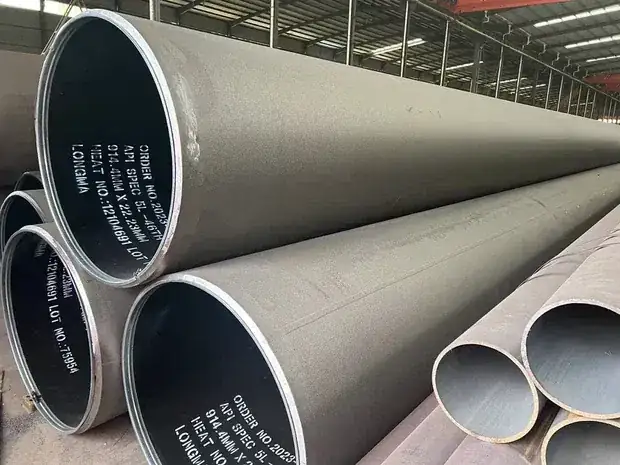
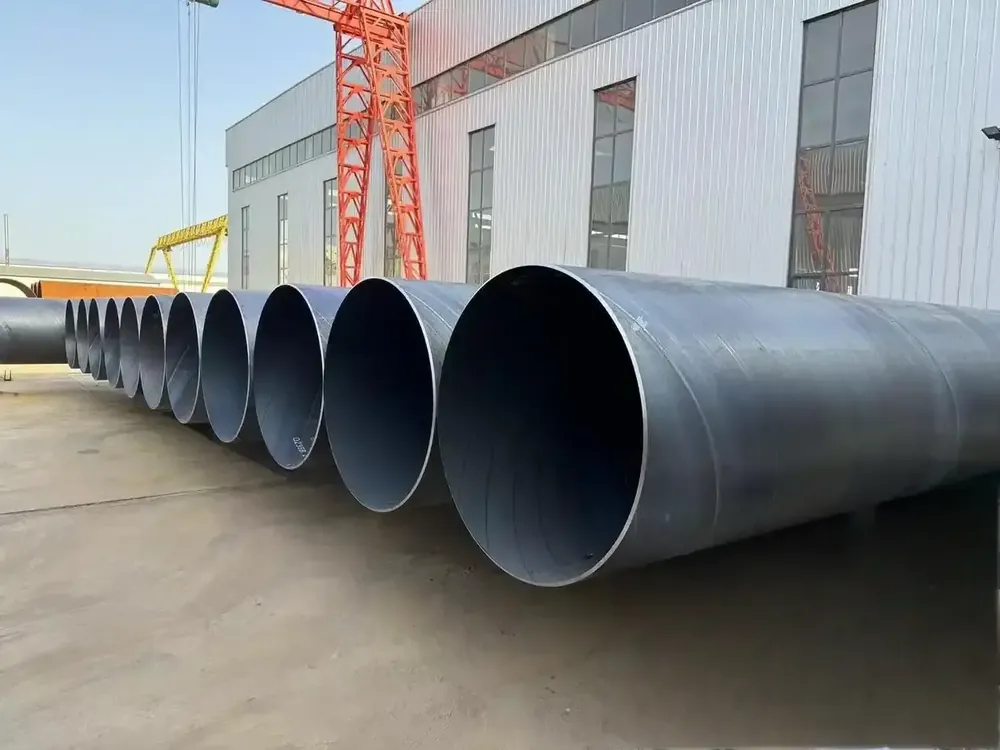
LSAW (Longitudinal Submerged Arc Welded) steel pipe is a large-diameter welded steel pipe manufactured by forming steel plate into a cylindrical shape and welding the longitudinal seam using the submerged arc welding process.
It is commonly used in oil and gas transmission, water pipelines, offshore engineering, and structural projects where high strength, reliable weld quality, and large-diameter specifications are required.
LSAW Steel Pipe Specifications
Product Name
LSAW Steel Pipe
Full Name
Longitudinal Submerged Arc Welded Steel Pipe
Manufacturing Process
JCOE, UOE or other applicable forming processes
Outside Diameter (OD)
406–1,524 mm (16–60 inches), depending on production capability
Wall Thickness (WT)
6–40 mm; thicker walls available for selected specifications
Length
6–12.5 m, with custom lengths subject to production capability
Steel Grades
API 5L Gr. B, X42, X52, X60, X65, X70 and other available grades
Applicable Standards
API 5L, ISO 3183 and other project-specific standards, as applicable
Relatively low for standard diameters and walls — typically one container load for 6 m lengths, or one break-bulk parcel for 12 m large-diameter pipe; trial quantities quoted on request
Delivery Time
Standard sizes ship ahead of made-to-order diameters; coating, PSL2 and third-party witness add their own slots. Confirmed per order, first reply within 8 working hours
Inspection
Dimensional inspection, weld NDT, hydrostatic testing and other specified tests
Applications
Oil and gas transmission, water pipelines, structural engineering and offshore projects
Choosing the Diameter and Wall Thickness Band
LSAW runs from 16 in to 60 in, and the same mill rolls all of it. What changes with size is not only the price per ton but how the pipe is lifted, shipped and welded on site — which is why the diameter band often decides more of a project than the grade does. The three bands below cover the range we produce.
406–610 mm
Typical 6–16 mm · 16–24 in
Roughly 0.7–2.8 t per 12 m length, so standard lifting gear and 20 ft containers can handle it.
Holds ovality well after expansion, which is what automatic girth welding on site depends on.
Walls under 8 mm need internal bracing once stacked, or the bore flattens in the yard.
Usually specified for: municipal water and sewer mains, plant cooling circuits, low-pressure gas distribution, piling casings.
610–1,016 mm
Typical 10–25 mm · 24–40 in
About 2–7 t per 12 m length, so twin-hook lifting or a spreader beam is needed for unloading.
Site cost shifts from the plate to handling: line-up clamps, side booms and welding crews set the pace.
Fixed 12 m lengths no longer fit a container, so freight is planned as break-bulk.
Usually specified for: onshore oil and gas gathering and transmission, water trunk mains, river-crossing casings, plant process piping.
1,016–1,524 mm
Typical 20–40 mm · 40–60 in
Approximately 9–19 t per 12 m length; stringing, lifting and alignment need purpose-built equipment.
Only JCOE or UOE forming can close a seam at this size, and expansion plus UT set the final roundness.
Test pressure and end squareness decide whether the girth weld fits first time, not tonnage.
Usually specified for: high-pressure transmission trunk lines, inter-basin water transfer, offshore and coastal structures, large structural sections.
Not every outside diameter and wall thickness inside a band can actually be rolled: the wall is limited by plate width and by the expansion ratio the line can hold. Send the diameter, wall, grade and length together and feasibility is checked against the line before a price is quoted.
LSAW Steel Pipe Size Chart
Every nominal size we roll, with the outside diameter and the wall range available against it. Treat this as the reference list for confirming a line size — the band guidance above explains what each size does to lifting, freight and site welding.
Nominal Size
Outside Diameter (mm)
Wall Thickness Range (mm)
16"
406.4
6–20
18"
457.2
6–22
20"
508.0
6–25
24"
609.6
8–30
28"
711.2
8–35
32"
812.8
10–38
36"
914.4
10–40
40"
1,016.0
12–40
48"
1,219.2
14–40
56"
1,422.4
16–40
60"
1,524.0
18–40
Which API 5L Grade Fits the Duty
The grade fixes the minimum yield strength, and that in turn fixes how much wall a given design pressure needs — design pressure is calculated as 2St/D, so a higher grade buys a thinner wall for the same pressure. Over-specifying adds cost without adding service life; under-specifying forces a heavier pipe and heavier freight.
Grade
Min. yield (MPa)
Min. tensile (MPa)
Normally specified for
Gr. B
245
415
Water mains, low-pressure gas distribution, structural and piling work
X42
290
415
General transmission at low to medium pressure, plant piping
X52
360
460
Onshore trunk lines, city gas networks, medium pressure service
X60
415
520
Long-distance oil and gas lines at higher design pressure
X65
450
535
High-pressure, large-diameter transmission
X70
485
570
High-pressure, high-throughput lines where lower tonnage matters
PSL1 or PSL2 — the choice that changes the test programme
Both are API 5L. The product specification level decides how much testing and documentation sits behind the pipe, and it is the item most often left vague in an enquiry.
Requirement
PSL1
PSL2
Chemical composition
Basic limits
Tighter: C ≤ 0.22%, P ≤ 0.025%, S ≤ 0.015%, CE ≤ 0.43
Charpy impact test
Only when specified
Mandatory, per test unit
Weld inspection
As agreed at order
Mandatory on the full seam
Yield / tensile ratio
Not limited
≤ 0.93
Traceability
As agreed at order
Heat number carried to the pipe and the certificate
Marking
Standard marks
PSL2 and additional marks required
Most cross-country transmission, offshore and low-temperature work is specified to PSL2. If a specification says only “API 5L”, confirm the PSL level before the plate is ordered: it changes chemistry, testing, documentation and cost, and it cannot be added after the pipe is rolled.
Dimensional Tolerances and Acceptance
Tolerances are where a quotation is tested at site. Girth welding depends on outside diameter, ovality and end squareness; design pressure depends on wall thickness. The values below are the ones normally applied to SAW line pipe.
Parameter
Typical API 5L requirement
Why it matters on site
Outside diameter
±0.75% of OD on the body; ±0.5% at the ends for PSL2
Sets the fit-up gap at the girth weld
Wall thickness
+15% / −12.5% of nominal
The minus side reduces calculated design pressure
Out-of-roundness
≤ 0.015 D, measured at the pipe ends
Elliptical ends cannot be lined up by clamps alone
Straightness
≤ 0.2% of length, about 24 mm over 12 m
Affects stringing, bending and pig passage
Length
6–12 m; fixed lengths cut to +50 / −0 mm
Fixed lengths suit automatic welding; random lengths shift cutting to site
End squareness
≤ 1.6 mm deviation around the circumference
Square ends are the base for a consistent root gap
Bevel
30° +5°/−0°, root face 1.6 ± 0.8 mm
Matches the field welding procedure and consumables
Where a project specification is stricter than API 5L — common on trunk line and offshore work — the purchase order governs. Send the inspection and test plan with the enquiry and the quotation is built against the tolerances you will actually inspect to.
JCOE Forming and LSAW Welding Technology
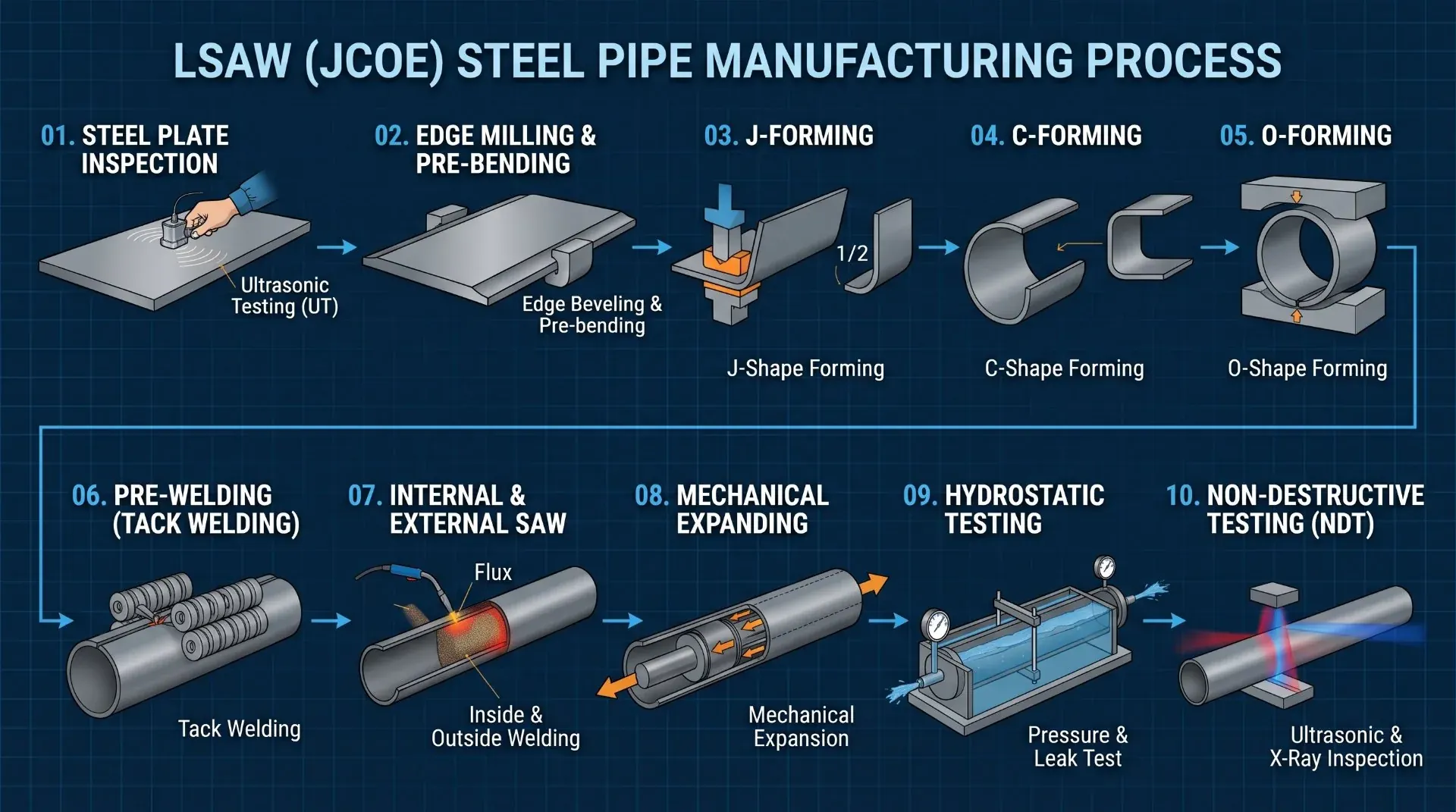
JCOE is a forming process used to manufacture large-diameter LSAW steel pipes from steel plates. The plate is progressively pressed into a J-shape, C-shape, and O-shape before the edges are joined and the pipe is expanded to the required dimensions.
The longitudinal seam is welded using submerged arc welding (SAW), typically with internal and external welding passes. This process produces a continuous longitudinal weld designed to meet the specified strength and quality requirements.
Key Manufacturing Stages
01
Steel Plate Inspection
Plates are checked for grade, thickness and dimensions, and ultrasonically tested for laminations before forming, so that defects are not carried into the finished seam.
02
Edge Milling & Pre-bending
Both long edges are milled to the welding bevel and pre-bent in a press so that the finished pipe keeps a true circular section at the seam.
03
J-Forming
The plate is pressed in steps from one edge against a lower die, forming a J profile across roughly half of the plate width.
04
C-Forming
The opposite half is pressed into a C profile, so both edges come together and the plate is ready for closing.
05
O-Forming
A final pressing stroke closes the C shape into a full O, with the longitudinal edges aligned and the gap set for welding.
06
Pre-Welding (Tack Welding)
The longitudinal seam is tack welded inside and outside to lock the geometry before the main welding passes.
07
Internal & External SAW
Submerged arc welding is applied to the inside and then the outside of the seam, with flux coverage and pass sequence set by wall thickness and the qualified welding procedure.
08
Mechanical Expanding
The pipe is expanded by a mechanical mandrel to improve roundness and dimensional accuracy, straighten the body and relieve welding stress.
09
Hydrostatic Testing
Each pipe is filled and pressurised to the specified test pressure, held for the required time, and the seam is inspected for leakage during the hold.
10
Non-Destructive Testing (NDT)
The longitudinal seam is examined by ultrasonic and X-ray methods. Final dimensions, end bevels, marking and coating are verified before delivery.
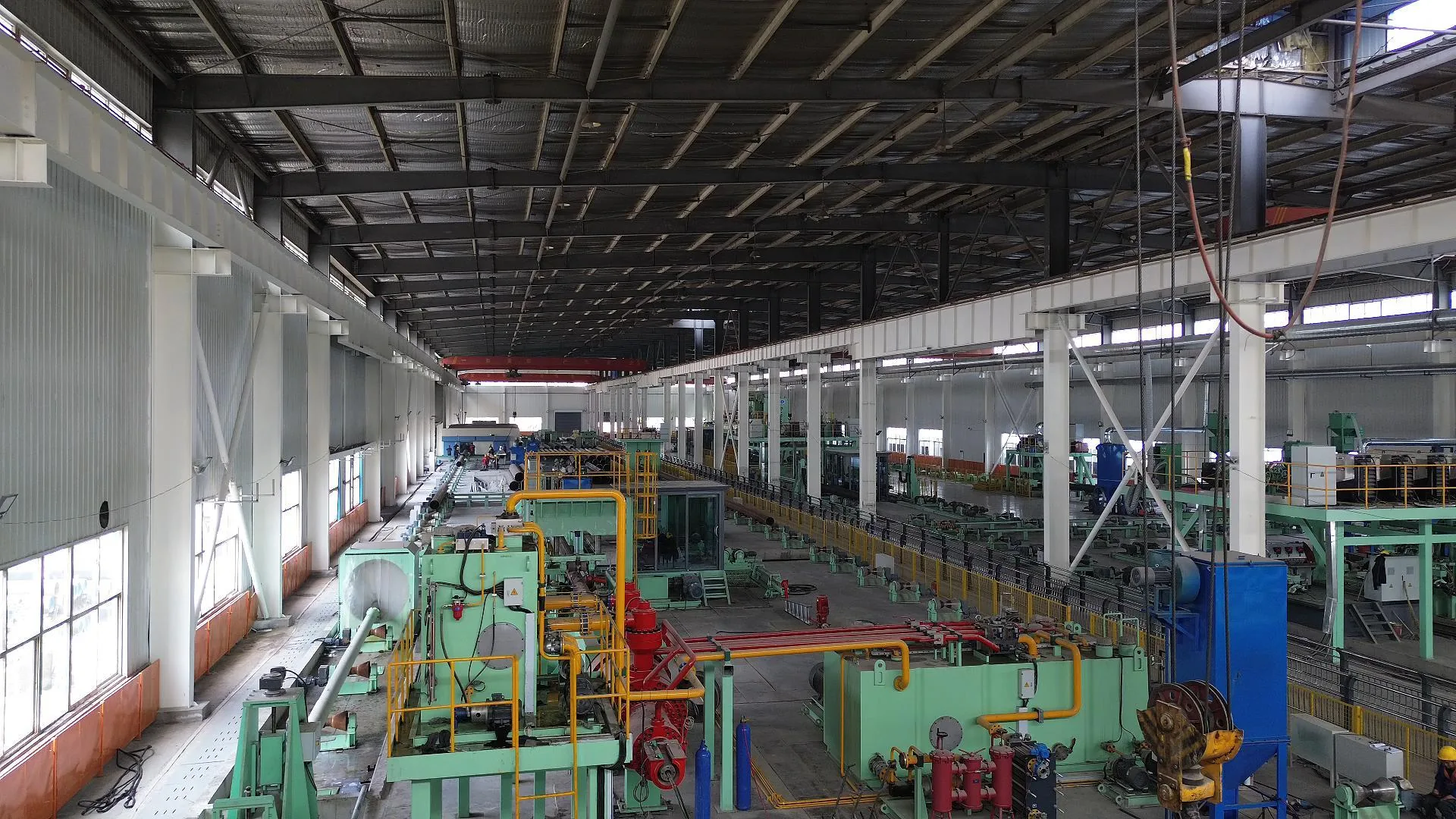
The JCOE production hall at our Cangzhou works, where plate is formed, welded and expanded into large-diameter LSAW pipe.
The JCOE process offers flexibility in producing large-diameter, heavy-wall steel pipes. Final dimensional accuracy, weld integrity, and mechanical properties depend on material quality, process control, and the specified inspection requirements.
Inspection, Third-Party Witness and Traceability
Every length is tested at the points where a defect would otherwise reach the field. Nothing below is sampled unless the standard says so.
01
Incoming plate
Heat number, chemistry and mechanical properties are checked against the mill certificate, and plate edges are ultrasonically scanned for laminations before cutting.
02
Forming and fit-up
Circumference, ovality and weld gap are measured after O-forming. The seam is tack welded only when the gap is inside the qualified range.
03
Welding records
Internal and external SAW passes follow a qualified WPS; current, voltage, travel speed and flux are logged per pipe, so a weld can be reproduced or investigated later.
04
Weld inspection
The full seam is examined by ultrasonic testing after welding. Radiography or digital radiography is added on lengths where the specification or the client's ITP calls for it.
05
Hydrostatic test
Each pipe is filled and held at the test pressure calculated from 2St/D for the specified hold time, with no leakage permitted at the seam or the ends.
06
Dimensional check
OD, wall thickness, length, bevel, squareness and straightness are measured on every length. Wall thickness is checked at the ends as well as on the body.
07
Marking and records
Heat number, pipe number, size, grade and PSL are stencilled on each length and carried into the mill test certificate.
Third-party inspection
Inspection can be arranged at the client's nomination — SGS, BV, TÜV or another agency — with witness points at plate verification, weld inspection, hydrostatic testing, coating and pre-shipment. Hold points, sampling rates and acceptance criteria follow the ITP issued with the purchase order, not our internal standard.
Traceability to the heat
Documents are issued to EN 10204 3.1: the certificate is specific to the heats actually rolled into the order, and the heat number on the certificate matches the stencil on the pipe. That link is what lets a length lifted from a stack two years later be traced back to the plate it came from, and it is the first thing a third-party inspector checks.
LSAW Steel Pipe Applications
LSAW steel pipes are widely used in large-diameter pipeline and heavy-duty engineering projects that require reliable weld quality, high strength, and controlled dimensional accuracy.
🛢️ Oil and Gas Transmission
Used in onshore and selected offshore pipeline systems for transporting crude oil, natural gas, and other fluids.
💧 Water Transmission
Suitable for large-diameter water supply, municipal water distribution, and long-distance water conveyance pipelines.
🌊 Offshore Engineering
Applied in offshore structures and marine pipeline projects, subject to project-specific design and material requirements.
🏗️ Structural Engineering
Used in heavy-duty structures, bridge components, and large-scale infrastructure projects where large-diameter steel pipes are required.
⚡ Energy & Industry
Used in power plants, industrial fluid transportation, and other infrastructure applications requiring specified mechanical properties.
The appropriate LSAW pipe specification depends on operating pressure, pipe diameter, wall thickness, steel grade, corrosion protection, and the applicable project standards.
Packing, Handling and Shipping
Large-diameter pipe is easily damaged between the mill and the trench, and the damage usually stays invisible until the girth weld fails to fit. Four things prevent it.
Internal bracing
Large-diameter, thin-wall pipe gets star bracing or a steel cross inside the bore before stacking, so the section keeps its shape under its own weight.
End protection
Bevels are fitted with end caps or protectors. A nicked bevel means re-cutting on site, which costs far more than the protector.
Stacking and lashing
Timber or sandbag separators between layers, stack height set by diameter and wall, and saddles with straps for sea transport.
Coating care
3LPE and 3LPP take point loads badly and are lifted with wide slings, never wire rope directly on the coating. Long storage is kept off the ground.
Three ways to ship it
Method
Normally used for
What to plan for
Container, 20 or 40 ft
Short lengths up to about 6 m, smaller diameters, trial and mixed orders
Lowest freight per shipment, but length is capped and loading is manual
Break-bulk vessel
Standard 12 m lengths in parcel sizes
Needs a stowage plan, timber dunnage and the port's lifting gear
Dedicated pipe carrier
Large parcels of big-diameter or heavy-wall pipe
Best hold utilisation, but the parcel must be big enough to fill a hold
For 12 m large-diameter pipe, container shipping is rarely economic. Most orders ship break-bulk or on a pipe carrier, and the packing method is agreed before the order is confirmed rather than after.
Frequently Asked Questions
The minimum order quantity depends on the pipe type, diameter and wall thickness. For standard diameters and walls it is relatively low: a container load for 6 m lengths and smaller diameters, a break-bulk parcel for 12 m large-diameter pipe. Send the specification and the destination port in the enquiry and the smallest workable quantity comes back with the price, usually within 8 working hours.
Standard diameters and wall thicknesses are rolled sooner than made-to-order sizes; heavy wall, PSL2, coating and third-party witness each take their own slot on the line and in the test bay. The firm date is given in the quotation against your specification, normally with the first reply within 8 working hours.
At the same diameter and wall thickness, welded pipe is normally the lower-cost route, and above about 24 in it is the only practical option. Seamless keeps the advantage at small diameter, very high pressure, high temperature and some sour service, where the absence of a seam matters more than the price.
Sour service is governed by NACE MR0175 / ISO 15156, which controls hardness, chemistry and toughness rather than pipe size. Whether a given diameter, wall and grade can be supplied to that specification has to be confirmed against the heat analysis and test results before the order; it is not something to assume from a catalogue page.
Yes. Fixed lengths are cut to +50 / −0 mm, which is what automatic girth welding and line-up clamps expect, and they are quoted with a small allowance for cut loss. Random lengths cost less but move the cutting to site.